Top Plate Preparation
An ITO coated piece of glass is used as the top plate to enclose the droplets and provide the “common” electrode. It must be prepared with a hydrophobic coating, tape spacers to maintain the gap between the top plate and the dielectric, and copper tape for making electrical contact to the ITO.
Materials
ITO Coated Glass Plate
It’s possible to use a variety of top-plate sizes, but the PurpleDrop frames are designed around two sizes:
50x50x1.1mm - Adafruit P/N 1310, or similar
50x75x1.1mm - Delta Technologies P/N CB-90IN-S211, or similar
ITO glass is often sold with different ITO coating thickness/resistivity. For use in a DMF device, this is not critical; any available ITO thickness will work.
6mm copper tape with conductive adhesive
Cytonix Fluoropel PFC1101V (https://cytonix.com/collections/electrowetting/products/1101v)
Alternatively, Teflon AF1600 solution is known to be a good hydrophobic coating for this application, and seems to provide better resistance to fouling in the presence of proteins or streptavidin beads.
Tools
Pipette capable of dispensing 400uL
Electrical Multimeter
Tweezers
Spin coater
Oven or hot plate
Wire cutters/strippers
Procedure
Clean ITO side of glass
First, identify which side of the glass is ITO coated using a multimeter to measure resistance; the ITO side will be conductive.
Clean the surface. You can use isopropyl alcohol and kim wipes, or an ultrasonic bath, if available.
Place the copper tape
Apply the copper tape over one edge of the ITO glass, so that it folds over approximately equally onto both sides of the glass. The copper tape will provide a conduction path from the ITO to the opposite side of the glass for connection later.
Although not necessary, if you are building multiple top plates there is a 3d-printable jig to help apply the tape: https://github.com/uwmisl/purpledrop-3dmodels/tree/main/tapejigs
Attach spacers
Spacers can be used to control the distance between the top-plate and the mylar film surface. The gap size can be varied by adjusting the thickness of the spacers used. A typical gap size used with PurpleDrop is in the range of 0.2 to 0.4mm. To support larger volumes, a larger gap can be used (e.g. 2-3mm), but the splitting of drops will become impossible to achieve.
There are multiple options that can work for spacers/shims under the top plate. But one simple option that works well is kapton tape. The tape is usually thin (available as thin as 0.025mm, but it varies) and can be layered to achieve different thicknesses.
To construct kapton spacers, multiple layers of tape should be stacked to the desired thickness, and small squares can then be cut out of the stack and placed onto the top plate (on the ITO side). Here it’s useful to re-use the backer from the 3M adhesive sheets used to bond the mylar film when building the dielectric carrier, as it has a low surface energy and will peel away from the tape more easily.
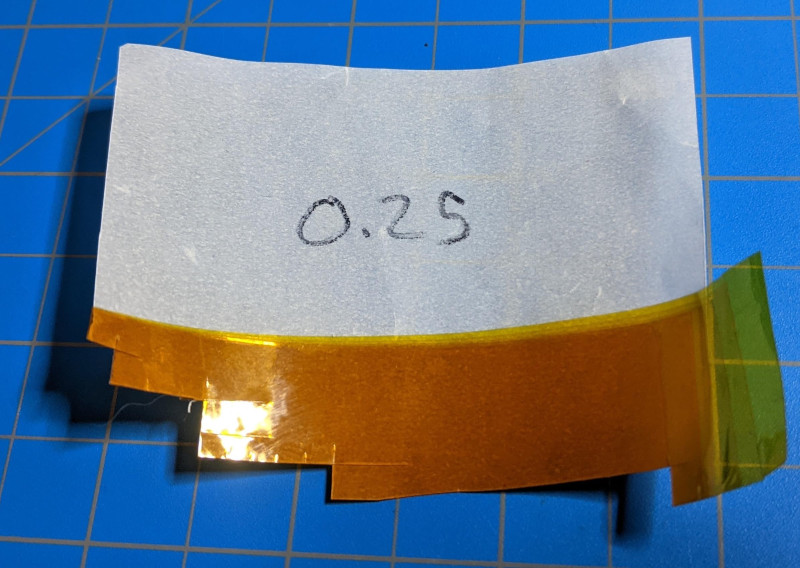
Multiplate layers of kapton tape layered onto adhesive backing paper, ready to be cut into small shims for top plate
While placing the spacers, it is important to avoid touching the active area of the top plate. The hydrophic coating can be easily damaged, and this can result in drops being unable to move past certain spots on the surface.
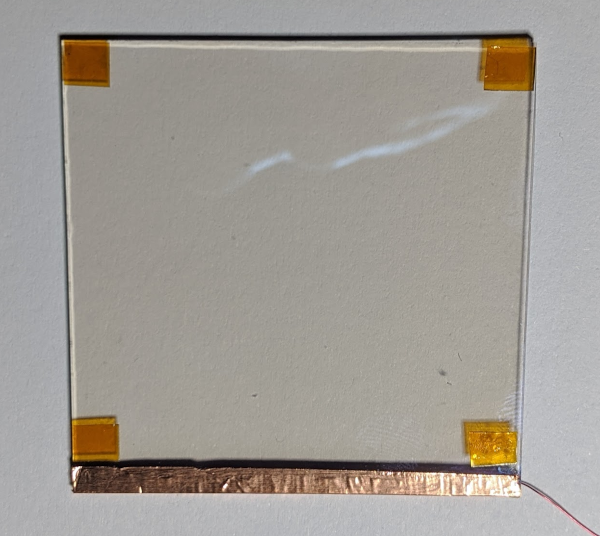
Top plate with spacers
Spin coat
Place the ITO glass into a spin coater, with the ITO coating face up. Spin at 1000RPM, and apply ~400uL of FPC1101V while spinning using a pipette. Allow to spin for 30 seconds after application.
Bake
Remove the glass from the spin coater, being careful not to disturb any active areas of the coating, and place it into an oven – or on a hot plate – to bake at 120C for 30 minutes.
Optional: Solder connector
We recommend using a cover with conductive gasket to make electrical connection to the top plate, but it’s also possible to solder a wire onto the copper tape to avoid the need for a cover.
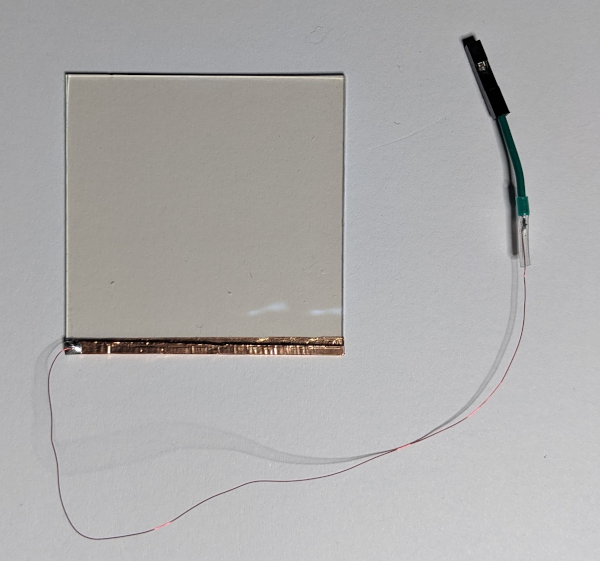
Top plate with attached wire
Here, you can see that the relatively large guage wire that comes with the jumper was cut off, and a small (34AWG) enamel coated wire (sometimes called “magnet wire”) was spliced on to replace it. It’s helpful to use a small, flexible wire here, as this limits the force the wire will exert on the top plate.
Re-use
The drop surface has a limited usage lifetime; it will eventually become fouled, and drops will not move freely. When your surface becomes fouled or damaged, you can re-use a top plate by cleaning off the hydrophobic coating with lab wipes and IPA, and re-coating. If cleaned carefully, even the kapton spacers can typically be preserved.